

Technology companies are racing to build a new wave of power-hungry data centers, some drawing as much energy as an entire city. Utility commissions and stakeholders across the country are debating whether the grid can handle them. But while that debate plays out, data center developers are looking for alternatives.
High-impact loads (HILs) like data centers can access power in three ways: (1) use the existing grid system and resources, (2) build behind-the-meter and/or self-supply resources, using the grid as backup, or (3) build an islanded facility. Islanded (off-grid) high-impact loads are getting a lot of hype. Why? Speed to Power. The faster these facilities connect the sooner they earn revenue. Building off grid may not speed up construction timelines for the data center itself, but it may save time by avoiding processes for electric utility service. Avoiding interconnection queues and grid impact studies could potentially save months, if not years, in development timelines.
HIL developers are seeking immense amounts of power and moving at warp speed within a regulatory paradigm designed to be slow, methodical, and prudent. The goal of utility regulation is to align private interests with the public interest and protect consumers. And yet, in the past year, a handful of states adopted laws exempting islanded HILs from energy regulation. A bill introduced in Congress in January would do the same. Supporters argue that it allows projects to move forward while protecting ratepayers and the grid. But islanding a high-impact load may not be the panacea decision makers seek. These facilities still leave ratepayers, utilities and the grid, and public policy at risk. Decision makers should carefully analyze the implications of these developments.
What are Islanded High Impact Loads?
There is no single definition of an islanded high impact load, but recent legislation and developments themselves converge on two critical elements. First, the facility is completely isolated from the bulk electric power system and other utilities. Physically, this differentiates it from behind-the-meter (or co-located) developments and other grid-connected configurations like a microgrid or energy park. Second, they are largely or entirely exempt from economic regulation by state utility commissions, though they may remain subject to other siting and permitting or air quality laws and regulations. We see both these elements in legislation passed in New Hampshire, Ohio, Oklahoma, and Utah.
Table 1 offers three examples of islanded HILs that demonstrate the enormous scale of the facilities being proposed by data center developers. All three rely heavily on natural gas. And while all three propose aggressive construction timelines, it hasn’t been smooth sailing. Fermi America is experiencing management disputes and project delays. xAI is the target of a lawsuit from the NAACP over Clean Air Act violations, and the US EPA ruled against xAI’s classification and use of “non-road engines”, requiring they seek proper permitting.
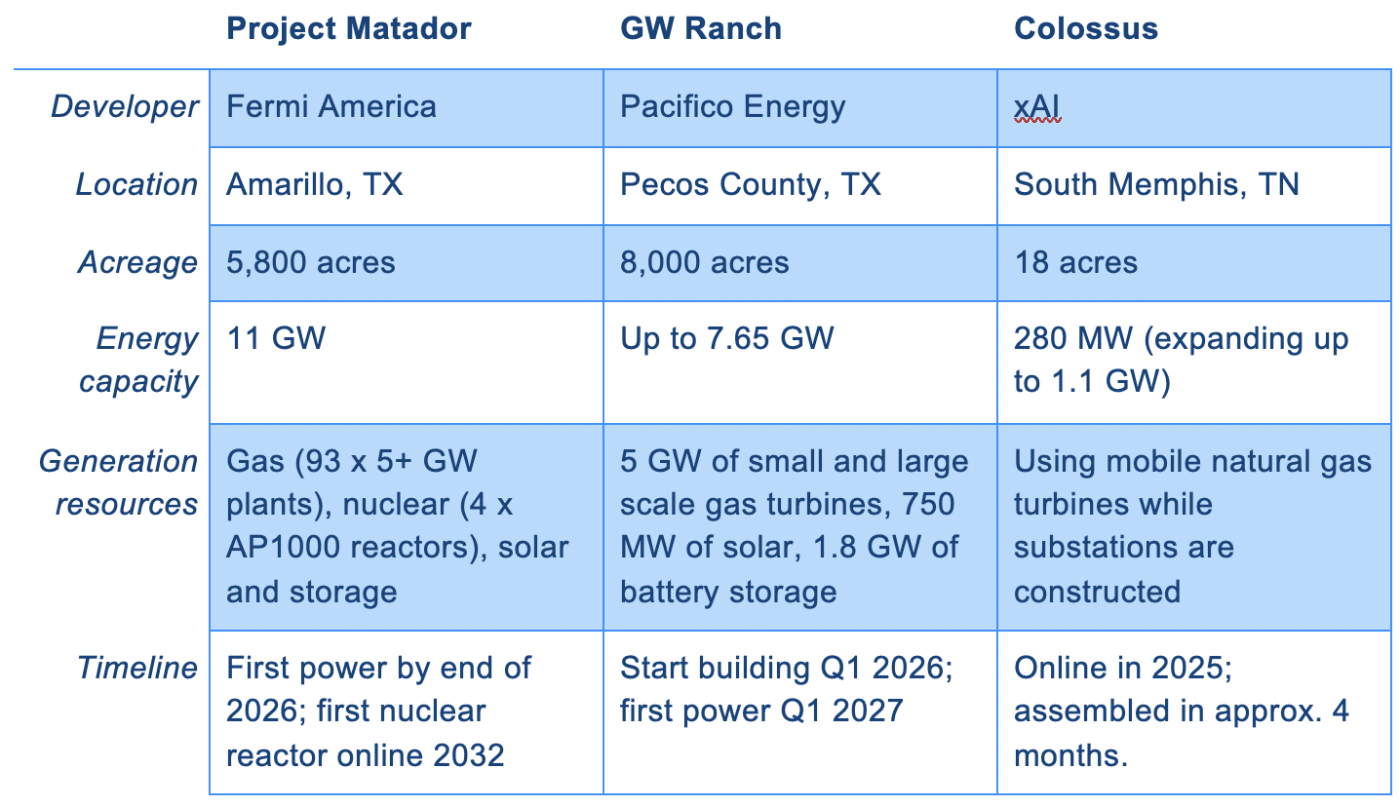
A major uncertainty about islanded loads is their intent to eventually connect to the grid. The Colossus project is planning to do so, using temporary generation until substations are constructed. But consider Project Matador. If the nuclear reactors aren’t completed on schedule in 2032, for example, will it seek a grid connection? It remains to be seen if the industry’s interest is islanding facilities is a permanent or temporary solution. If it is temporary, this raises reliability and resource adequacy concerns, discussed below.
Risks and Impacts
Despite being islanded, these facilities still pose risks to ratepayers, utilities and the grid, and public policy. In the table below, we assess and classify the risk of the primary impacts from these facilities. Given these risks, we outline two key considerations for decision makers in the immediate term.

Competition Over Resources and Electric Equipment
Developers backed with private investments have more financial capacity and fewer financial limitations than regulated utilities. This advantage tilts the scales towards developers in any direct or indirect competition with utilities for generation resources, supplies, equipment and fuel. For example, Amazon recently outbid a Washington utility for a solar project, ultimately denying the utility and its customers a low-cost resource. During the bidding process, Project Matador developer Fermi America reportedly offered three times the market value for water rights to use for cooling its facility. Spikes in global demand for gas turbines are raising prices and increasing delivery times up to 5-7 years. We see the same impact in the market for transformers, where prices have nearly doubled.
Gas supply is another pressure point. Unlike with the electricity grid, it will be nearly impossible for islanded HILs to avoid relying on the same gas transmission infrastructure as utilities, which means direct competition. This includes gas distribution utilities that deliver directly to end users. Spikes in demand could increase customer bills or even threaten utilities’ ability to secure firm supply to serve existing customers. Islanded HILs are also likely to compete with electric utilities over gas supply for generation plants. Outbidding utilities could impact electric system resource adequacy and reliability. Gas plants are often the marginal resource in many regions, setting wholesale electricity prices. Higher fuel prices would raise those wholesale prices. These pressures will be acute in areas already facing limited gas import capacity, such as Arizona.
Meanwhile, high-impact loads are seeking other, less efficient generation equipment including turbines designed for aircraft and warships or refurbished turbines from industrial operations. Lower efficiency means needing more fuel to meet their needs.
Decision makers should ask how competition over generation resources, supplies, equipment, and fuel will impact energy providers. They should ask what actions are being taken to ensure delivery and cost-containment. Alaska recently introduced legislation addressing concerns like these.
Resource Adequacy, Planning, and Interconnection
The sheer magnitude of high-impact loads, coupled with the potential for redundant or speculative bids, is challenging for planners. The uncertainty of an islanded facility’s intent to connect to the grid in the future deepens the challenge. If the facility is seeking a grid connection but can already fully serve its own load, it would reduce resource adequacy impact concerns. If it can’t serve its own load – being off-grid was a bridge to grid support, intentional or not – the subsequent connection may impact resource adequacy.
This is a critical “if.” Decision makers should ensure rules, regulations and interconnection standards address the necessary protections and requirements for these loads before interconnecting. These systems would not undergo the same rigorous analysis of a grid-connected system and could pose reliability risks impacting the safety and operational efficiency of the grid. For example, data centers tripping offline due to voltage fluctuations from the grid can cause drastic and rapid changes in load, an issue expected to become more common. This can be prevented using safeguard equipment, but systems designed without grid connection in mind may not have these protective devices.
Decision makers should ask utilities and market operators if they are considering islanded HILs in their planning forecasts. What justifications do they have for including or excluding them? If these loads seek to connect, what processes and equipment are necessary to ensure safety and reliability for a load of this scale that was not designed for interconnection?
Conclusion
Islanding a high-impact load is not a silver bullet. It may mitigate direct impacts to the grid and ratepayer to some degree, but risks intensifying others. Decision makers must carefully consider the exemptions being extended to these facilities and how their development, despite being islanded, leaves ratepayers, utilities and the grid, and public policy at risk.
For more on this topic, visit RAP’s online hub of resources, Data Centers and the Next Era of Energy Regulation.