Millions of Americans struggle to afford their power bills. In 2024, 13.4 million residential electric customer disconnections occurred, and 27.1 million final disconnection notices were issued to residential natural gas customers, numbers that significantly exceed previous national estimates. The consequences for those who cannot afford energy can be severe, from health risks to compounding financial hardship.
But what are the consequences of customer bad debt for the rest of the system? Bad debts are unpaid customer bills that utilities can’t recover plus what the utility spent pursuing those debts. Those unpaid bills and the cost to collect them flow into utility revenue requirement, where they are ultimately paid for by every residential customer on the system.
Most state regulatory frameworks for collecting on past-due residential utility accounts have rested on the same three tools for decades: a cash security deposit at service initiation, late and reconnection fees, and a shutoff for persistently delinquent accounts. These tools made sense when the cost of remote reconnection was high and commissions could not reasonably require utilities to maintain the data and program administration necessary to sustain low-income payment assistance. But today, the technology and policy environment around residential utility billing has changed significantly.

A growing body of work proposes a concrete alternative: rely less on deposits, fees, and shutoffs, and more on two payment programs designed for households who fall behind: arrearage management programs (AMPs), in which the utility forgives a portion of a customer’s past-due balance over time in exchange for the customer paying current bills on time, and percentage-of-income payment plans (PIPPs), which cap the current bill at a manageable share of household income for those customers who meet low-income qualifications.
The case for proactive intervention is based on conventional regulatory grounds: if the entire customer base bears the cost of nonpayment, then the savings from preventing nonpayment should be shared by all customers. Massachusetts data on its arrearage management program (AMP) show participating utilities recover a substantially larger share of billed amounts from enrolled customers, with one utility reporting roughly a 50% increase in its “bill coverage ratio” after enrollment. This savings belongs in the cost-benefit ledger when a commission reviews a utility’s collections practices.
Below, we share recommendations for utilities and commissions to consider when building AMP and PIPP programs. They are sequential in logic, but each can be adopted on its own timetable.
Measure what matters.
Disconnection and arrearage data should be reported at a granular level: zip code at minimum, census tract where data systems support it, and disaggregated between general residential customers and those identified as low-income. The EIA survey gives commissions a federal floor to build on; but effective state reporting should go further.
In the EIA’s November 2024 comments on the proposed survey, NARUC and NASUCA recommended that EIA collect five additional categories of data beyond notices, disconnections, and reconnections: disaggregated arrearages by length of time (1–30, 31–60, and 61–90+ days past due); payment plan participation and defaults; energy assistance enrollment; uncollectible accounts written off; and duration of disconnection. NARUC has also called for tracking displacement, customers who are disconnected and never reconnect at the same address.
EIA adopted none of these. The April 2026 report explicitly acknowledges the duration gap: “We did not collect information on the duration of the disconnection, which could range from a brief interruption in service to a permanent disconnection.” State commissions building above the EIA floor should treat the five omitted categories as the minimum additional scope.
Replace punitive collections with arrearage management and low-income rates.
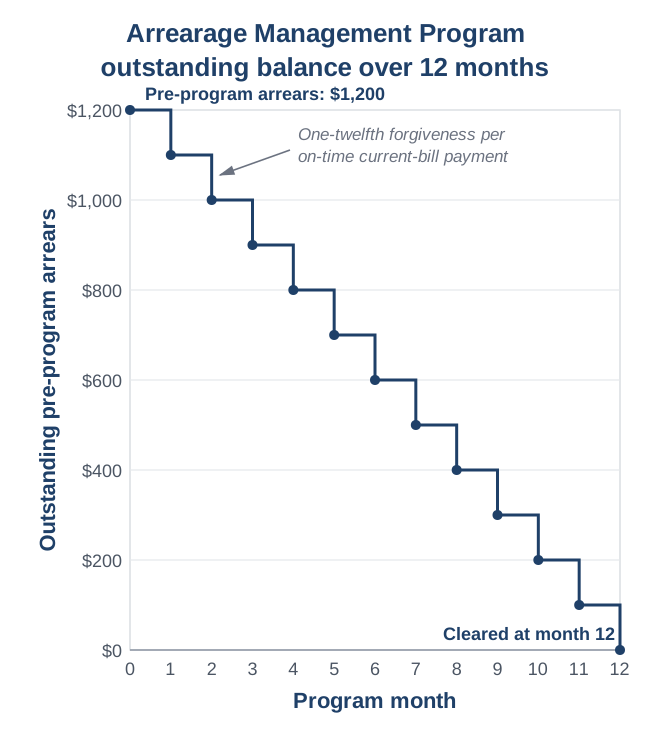
AMPs and PIPPs are the workhorse instruments here. Under a typical AMP, the utility forgives a defined share of pre-program arrears. usually one-twelfth per month, in exchange for consistent on-time current payments. A PIPP holds the current bill at a fixed share of household income, typically 3% to 6%, so customers can realistically complete the AMP.
These programs work best when paired with the elimination of policies that work against them: cash security deposits on low-income residential customers, late and reconnection fees in jurisdictions where advanced metering has driven the cost of remote reconnection to near zero, and opaque “risk-ranking” of accounts for accelerated termination.
Update protective frameworks for current weather and populations.
Most state winter-moratorium policies emerged in the late 1970s and 1980s in response to cold-weather deaths following nonpayment disconnections of vulnerable households. The protected population has not changed. Meanwhile, deaths associated with high temperatures climbed by 53%, from an annual average of 2,670 between 2000 and 2009 to more than 4,000 between 2010 and 2020. As a result, several commissions have begun to update their weather-related moratoria to include summer heat protections.
Benchmark performance with normalized financial ratios.
Without standardized metrics, commissions cannot tell whether a utility’s collections performance is improving, deteriorating, typical or whether reforms like AMPs are paying off. Raw dollar figures do not compare across utilities of different sizes, so researchers and policy leaders have developed a handful of normalized metrics.
The Gross Write-Offs Ratio (annual residential write-offs divided by annual residential revenue) puts performance on a common denominator, as Pennsylvania’s annual collections reports illustrate. Weighted Arrears (total arrears divided by the average customer bill) gives a “bills behind” index that controls for differences in local rates. The Money at Risk Index combines arrears with the balances of customers on payment plans to show total exposure over time. California’s Hours at Minimum Wage and Affordability Ratio metrics extend the same logic to rate cases, asking how a proposed bill increase would land on a household’s budget after housing costs.
Other options to consider.
Beyond PIPPs and AMPs, low-income rate designs are another option to help customers afford their bills. The two most common alternatives are flat percentage discounts and tiered discount rates.
Under a flat discount, every qualifying low-income customer receives the same percentage off the bill, which varies by jurisdiction but typically sits in the 15% to 30% range, with 20% to 25% being the most common. Eligibility is verified once, typically through enrollment in LIHEAP or another categorical program, after which the discount is applied automatically. Under a tiered discount, the percentage varies by income band. For example, the lowest income band receives a discount of 50% in Connecticut and a discount of 86% in New Hampshire.
These approaches are less precise than a PIPP. A flat 20% discount on a $300 winter bill still leaves a $240 bill that some low-income households may not be able to pay; a tiered discount can close the gap but has no individualized guarantee. PIPPs guarantee affordability by capping the bill at a share of income regardless of usage. But flat and tiered discounts are administratively simpler with fewer individualized steps.
Conclusion
The next step is putting this framework through actual rate cases. Commissions must implement how AMP forgiveness, PIPP discounts, and reduced collection costs flow through the revenue requirement and how the net effect on customers who are not enrolled is presented and tested for cost-effectiveness.
Two methodological points are key in those proceedings: AMP cost-benefit analyses tend to undercount their own operating-cost savings — the larger contributor to net savings in NCLC’s AMP report and the Oregon PUC’s low-income arrearage study. Yet operating-cost savings are routinely missing from filings on AMP cost-effectiveness and instead focus on utility bill write-off effects alone. Additionally, reporting and program design must move together because granular data reveal patterns that data alone cannot remedy, and a PIPP without account-level reporting is just as hard to evaluate as reporting without an underlying program.
Commissions that act ahead of the next round of large rate cases will have more options than those that wait, and the EIA-112 federal data, the maturity of program designs in Massachusetts and Ohio, and the affordability metrics now in use in California give them a usable starting point.