




About this Report:

The Clean Heat Policy Tracker is the world’s first global repository of national-level policies for decarbonizing heating. Its goal is to provide an up-to-date overview of heating policies, identify common approaches and highlight best practices. The 2025 edition includes 17 countries.
Meet the RAP Experts:


Acknowledgements
The Clean Heat Policy Tracker 2025 was designed and authored by Duncan Gibb and Richard Lowes (Regulatory Assistance Project/Clean Heat Forum). Chiara Delmastro (International Energy Agency), Sem Oxenaar and Shawn Enterline (Regulatory Assistance Project) provided valuable review.
Special thanks for their survey contributions to colleagues at UK Government, Scottish Government, Danish Energy Agency, Dutch Government, ECCO Italy, Efficiency Canada, French Government, German Energy Agency, Jordanian Government, Korea Heat Pump Alliance, PGE Polska and RAP (Bram Claeys, David Farnsworth, Ivan Petar Yochev, Jing Chen, Monika Morawiecka and Zsuzsanna Pato).
Editorial assistance was provided by Steena Williams (RAP). Web development was carried out by Laurel Scherer and her team at Status Forward.
Global state of clean heat policy
Heat decarbonisation is a critical element for achieving global climate goals, improving air quality and boosting energy security and independence. Heat is responsible for around 46% of global final energy demand, about half of which is consumed in buildings and the other half in industrial processes. Transitioning the heating sector away from combusting fossil fuels to using clean heating is a critical challenge.
Figure 1. Total final consumption and share of renewable energy, by energy source, 2022
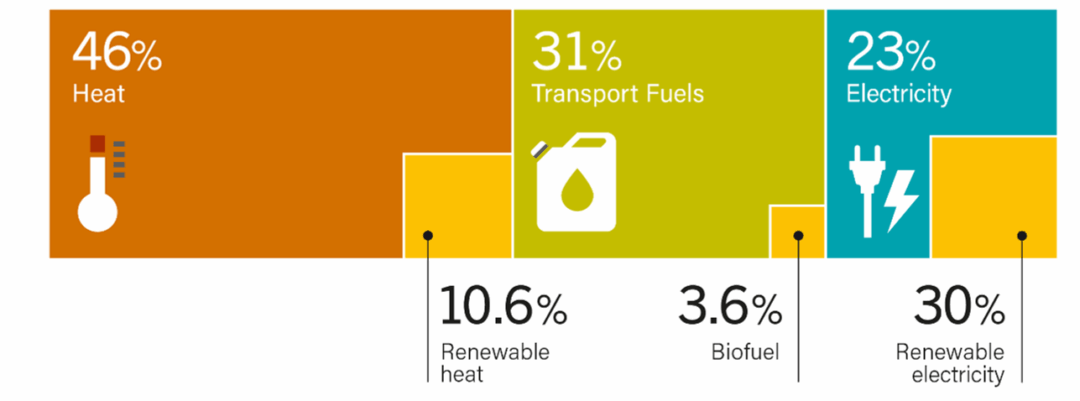
Source: REN21. (2025). Renewables 2025 Global Status Report: Global Overview.
Buildings carry a heavy burden in this regard. In 2023, buildings were responsible for 32% of global energy demand and 34% of CO2 emissions. Direct and indirect energy use in buildings, i.e. mainly heating, accounted for 25% of CO2 emissions. Compared to the progress of emissions reduction in electricity generation, heat and buildings are a long way behind.
Figure 2. Share of buildings in global energy and process emissions in 2023
In 2024, only some 16% of heat in buildings was supplied by renewable energy sources, with around 5% of that from bioenergy. Heat pumps and electricity for heat accounted for 8.2%. Other renewables, such as solar thermal heat, geothermal direct use and renewable district heat rounded out the total. Fossil fuels, which all lead to high GHG emissions and air pollution, still made up nearly two-thirds of global heating demand.
Figure 3. Energy consumption for heating in buildings, by source, 2024
There is a clear need for comprehensive policies to accelerate the uptake of clean heating in buildings. Clean heat, as considered here, encompasses technologies that result in lower lifecycle emissions and local air pollution than their fossil fuelled counterparts. These include heat pumps, geothermal heat, solar thermal and, depending on sustainability practices, bioenergy. District energy networks can be highly efficient infrastructure for distributing clean heat at low cost and without local air pollution. In some cases, electrical resistance heat can be considered “clean” as it also results in no local pollution, however it is much less efficient than heat pumps or modern heat networks and, depending on the fuel mix for electricity generation, may result in high greenhouse gas emissions.
To learn more about clean heating in buildings and the effective policies for decarbonisation, visit the following resources:
- Regulatory Assistance Project – A policy toolkit for global mass heat pump deployment version 2.0
- International Energy Agency – Heating, Buildings, Heat Pumps, District Heating
- Global Alliance for Buildings and Construction – Global Status Report for Buildings and Construction 2024/2025: Not just another brick in the wall
- Buildings Breakthrough
- Clean Heat Forum
The world’s first global clean heat policy tracker
The Clean Heat Policy Tracker is the world’s first global repository of national-level policies for decarbonizing heating. Its goal is to provide an up-to-date overview of heating policies, identify common approaches and highlight best practices. The assessment criteria are based on existing multi-institution analysis on how to encourage clean heat technologies, as well as engagement with members of the Clean Heat Forum on tracking criteria.
The 2025 edition contains information from 17 countries. These countries either responded to the survey or were prioritised for inclusion by the authors. The Tracker does not cover all countries in the world, nor does it represent all the world’s clean heating policies (see Disclaimer below). The countries include Belgium (Flanders), Bulgaria, Canada, China, Denmark, France, Germany, Hungary, Italy, Jordan, Korea, Netherlands, Poland, Portugal, Scotland, United Kingdom and the United States.
The analysis of these countries reveals a consistent, global preference for financial incentives to drive heat decarbonisation. However, foundational and structural approaches – such as heat decarbonisation frameworks, regulatory policies, energy pricing reforms and long-term heat pump targets – are far less common, indicating that most national frameworks are not yet comprehensive enough to achieve a full transition.
Many governments have introduced popular financial incentives to shift markets and encourage behaviours, yet overlook the transparency and certainty that clear regulations, realistic phase-out dates and long-term targets provide. Without a roadmap, the financial incentives risk becoming less effective and creating dependent markets.
Key Finding 1: Subsidies are the most common policy lever
Based on the survey data, the most common clean heat policy is subsidies for heat pumps, which are offered in 14 of the 17 surveyed countries. Other common approaches include policies designed to improve clean heat skills and raise public understanding, as well as district heating subsidies; 11 countries have measures in place for each of these areas.
This popularity of subsidies and awareness campaigns stands in stark contrast to the rarity of long-term, structural policies. For instance, only three countries included in the analysis have established a formal fossil fuel phase-out plan, and just two had set specific targets for heat pump uptake. This disparity reveals an unbalanced policy landscape.
Key Finding 2: Countries are lagging on regulation, pricing, and policy frameworks
This analysis groups individual policies into five core pillars, as outlined in the publication A policy toolkit for global mass heat pump deployment, revealing a clear disparity in their global adoption. The most common category is “Financial support,” with an average of 13 countries implementing policies in this area, comprising heat pump subsidies and district heating subsidies. The “Communication and skills” pillar is also well-represented, with an average of ten countries having relevant measures in place.
These findings highlight significant gaps in more foundational policy areas. “Regulatory policy” is the weakest pillar, with only four countries on average having such measures. Similarly, the pillars for “Policy framework and governance” and “Pricing reforms” are also lagging, with an average of just six and five countries respectively.
Lessons about the global transition
Overall, the data suggests a global tendency to prefer “carrots” (financial incentives) to encourage clean heat adoption. While important, in many cases these are not sufficiently supported by the “sticks” (regulations), energy pricing policies nor the long-term strategy (policy frameworks and targets) needed to ensure a complete heating transformation.
The common policies tend to be those that are most popular and easy to implement. Financial incentives rarely are controversial and jobs programs that focus on clean heat skills also are common among the countries surveyed. However, regulatory policies that restrict fossil fuel boiler installations can prove politically challenging, and comprehensive heat decarbonisation frameworks constitute an important political effort. As such, these approaches are less represented. All these pillars are necessary to ensure a rapid and equitable transition to clean heat within a country.
What’s more, in many countries the support schemes have been unstable and prone to change depending on the current government. A clear example is in the United States where a major support program was removed, however the heat pump market in Italy also has suffered due to a short-term change in its incentive scheme, as has been the case in other countries.
Without stronger regulatory policies, such as clean heat standards or restrictions on installing fossil fuel boilers, and clear long-term frameworks, the transition risks being too slow and reliant on short-term, unstable subsidies alone.
Explore the Data
The full dataset from the Tracker is available to explore below.
Policy Factsheets: Are you curious about what a successful ‘Regulatory Policy’ looks like? Want to see examples of financial support programs? Explore our Policy Factsheets for best practices from around the world.
Country Factsheets: Take a deep dive into the specific policy landscape of individual nations in our Country Factsheets section.
Policy Factsheets
The policy factsheets consist of examples of best practice from the countries assessed for the Clean Heat Policy Tracker 2025 edition. It does not strive to be a comprehensive overview of all countries yet highlights effective examples of each policy type that can be used as inspiration for other countries.
Framework and Governance
Countries with effective policy frameworks and governance tend to establish statutory national heat plans that provide a clear, long-term vision for decarbonisation. This is often complemented by municipal-level heat planning, allowing for tailored strategies, with progress publicly tracked and accessible to ensure accountability. Setting specific deployment targets signals strong government commitment and provides measurable installation goals.
Country
Best Practice
China announced in April 2025 an Action Plan to Promote the Development of the Heat Pump Industry, which aims to promote the use of heat pumps in various sectors and increase the product efficiency.
Denmark has a national heat plan with ambitious, statutory objectives for the decarbonisation of the heating sector, aiming for net-zero by 2035.
The Netherlands “National Plan for the Energy System” is updated every five years and sees municipalities leading implementation. Progress is publicly tracked, and a target of 1 million hybrid heat pumps by 2030 is in place.
Scotland’s “Heat in Buildings Strategy” is a statutory plan that outlines the country’s objectives for reducing emissions from heating in buildings. An upcoming Heat in Buildings Bill is expected to set a target to decarbonise heating by 2045.
South Korea’s “Integrated Energy Supply Act” establishes the legal framework for efficient and environmentally friendly district heating and cooling systems. The country plans to supply district heating to an additional 680,000 households by 2028.
Regulatory Policies
Effective regulatory policies establish clear mandates to transition away from fossil fuels. Best practices often include outright restrictions on fossil fuel heating systems in new buildings or existing buildings and clean heating obligations or standards to ensure new heating devices use a significant proportion of renewable heat.
Country
Best Practice
China’s regulatory policies mandate clean heating through national plans and mandatory building energy standards. The “Clean Winter Heating Plan” (2017-2021) drove the phase-out of coal, while the current policy (2022-2025) promotes new energy sources and heat pumps.
Flanders has progressively banned gas connections for large new building projects (2021) and oil heating in new buildings/retrofits (2022). All new builds will be gas-free by 2025, with increased renewable energy shares required.
Germany mandates that all new heating devices use 65% renewable heat from latest 2028, a rule directly linked to its heat planning law. The country plans a comprehensive fossil fuel phase-out by 2045.
The UK’s Clean Heat Market Mechanism places an obligation on manufacturers supplying gas and oil boilers in the UK market. Manufacturers must meet targets for the installation of heat pumps in existing properties in proportion to their sales of fossil fuel boilers.
Financial Support
Strong financial support mechanisms are crucial for accelerating the adoption of clean heat technologies by lowering high upfront costs for households and businesses. Best practices involve providing comprehensive and substantial grants for individual heat pump installations, covering a significant portion of the total cost. Zero-interest loans also play a role. Additionally, support for efficient and low-carbon district heating network expansion and modernisation is important.
Country
Best Practice
Canada offers significant financial programs, including loans up to CAD 40,000 and grants up to CAD 10,000 for heat pump adoption. It also commits substantial funds (CAD 800 million) for low-to-moderate income households.
France’s main subsidy programme, MaPrimeRénov, provides tiered subsidies based on household income. Energy suppliers provide grants to both low-income and all other households through the White Certificate programme. The Fonds Chaleur programme finances investments in clean heat production.
The UK’s Boiler Upgrade Scheme offers substantial grants of £7,500 for heat pump installations. Additionally, the Green Heat Network Fund and Heat Network Efficiency Scheme provide capital and pre-capital support for district heating projects.
Pricing Reforms
Best practices in pricing reforms aim to make fossil fuels less attractive and clean electricity more affordable. This includes implementing carbon taxes on fossil fuels and reducing or exempting taxes on electricity used for heating. Furthermore, widespread adoption of dynamic electricity pricing optimizes grid use.
Country
Best Practice
Denmark applies carbon taxes on fossil fuels for heating and offers a significant tax exemption on electricity used for heating, making electric heat pumps a more economic choice in most cases. It also has widespread adoption of dynamic electricity pricing.
Germany levies a fixed carbon tax on fossil fuels for heating. Plans are in motion to reduce the electricity tax to the European minimum, with ongoing discussions about reducing or capping grid charges to further incentivize electrification.
The Netherlands is reducing electricity taxes by approximately 25% from 2024-2030 while fossil gas taxes remain constant. This reform directly supports electrification by making electric heating more economically attractive.
Communication and Skills
To ensure rapid clean heat adoption and effective implementation, best practices in communication and skills development focus on educating and supporting both the public and the workforce. This involves supporting robust training and certification programs for installers, and comprehensive public information platforms and awareness campaigns to inform and engage consumers.
Country
Best Practice
Canada provides direct funding (CAD 500,000) for heat pump training for skilled workers. Natural Resources Canada has also released extensive technical guides and basic consumer information to improve public understanding of heat pump technology.
Various organizations, including industry associations and local governments, offer training for clean heat skills like heat pump installation and maintenance. This workforce development is backed by national and local policies designed to professionalize the sector and scale up deployment.
Denmark has a mandatory certification system for installers, significantly increasing certified professionals. It supports robust educational platforms for craftspeople and universities, alongside a comprehensive one-stop shop information platform, SparEnergi.
The UK has invested GBP 5 million in a Heat Training Grant, supporting over 6,500 trainees in heat pump installation. It also launched the “Warm and Fuzzy” campaign to raise public awareness and is making improvements to its’ Heat Pump Home Suitability tool.
Country Factsheets

















Disclaimer
A survey was conducted in the spring of 2025 to collect policy information for all the countries in the Clean Heat Policy Tracker 2025.
The Tracker does not cover all the world’s countries and does not represent all of the world’s clean heating policies. It is possible that some of this information is out of date. The Tracker will be updated annually. Please refer to government websites for the most up-to-date information.
Appendix
A full list of definitions for the terms in figures KF1 and KF2 can be found below. These encompass the questions that were asked in the survey distributed in March 2025.
Appendix 1. Policy terms and corresponding survey question.
| Carbon pricing | How many countries have a carbon tax on fossil fuels for heating? |
| Clean heat skills | How many countries support the development of clean heat skills? |
| Clean heat standard | How many countries have a clean heat obligation or standard? |
| District heating subsidies | How many countries provide financial support for district heating? |
| Existing buildings | How many countries have restrictions on installing fossil fuel heating appliances in existing buildings? |
| Fossil fuel phase-out | How many countries have a phase-out date for fossil fuels in buildings? |
| Heat decarb governance | How many countries have a specific body that governs heat decarbonisation? |
| Heat decarbonisation tracking | How many countries track the progress of heat decarbonisation? |
| Heat pump subsidies | How many countries provide financial support for heat pumps? |
| Heat pump targets | How many countries have targets for heat pump deployment? |
| Heating in NDC | How many countries have heat decarbonisation as part of their Nationally Determined Contribution? |
| Local governance | In how many countries is the heating sector governed locally? |
| National heat plans | How many countries have statutory heat plans? |
| New buildings | How many countries have restrictions on installing fossil fuel heating appliances in new buildings? |
| Pricing | How many countries have undertaken energy pricing reforms to advance electrification? |
| Public understanding | How many countries have taken efforts to improve public understanding and support of clean heat systems? |
Appendix 2. Policy categories and corresponding terms
| Policy framework and governance | National heat plans Heat decarbonisation tracking Buildings breakthrough Local governance Heat decarb governance Heating in NDC Heat pump targets |
| Regulatory policy | Clean heat standard New buildings Existing buildings Fossil fuel phase-out |
| Pricing reforms | Pricing Carbon pricing |
| Financial support | Heat pump subsidies District heating subsidies |
| Communication and skills | Public understanding Clean heat skills |