



As some Americans suffered through power outages and high electricity prices during Winter Storm Fern, other regions were curtailing power that costs nearly nothing to produce.
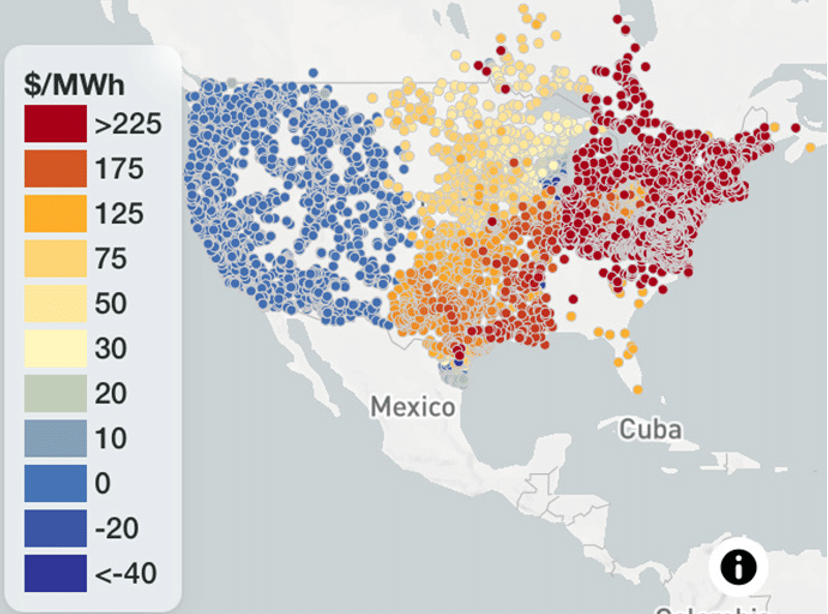
Studies show that well-planned transmission connecting utility footprints and regional grids can produce cost savings, electric reliability and other public benefits. These interstate electricity highways can improve power delivery to consumers across the U.S.
However, interregional transmission is challenging to finance as existing mechanisms either cause disputes over fair allocation of costs between different regions’ ratepayers or hinder merchant developers with investment uncertainty.
A hybrid mechanism that combines aspects of regulated and merchant financing has shown promise in overcoming these challenges. Introduced in 2014, this mechanism has facilitated development of several operational interconnectors between Great Britain and neighboring countries, totaling 5.3 GW of new transmission capacity so far and returning approximately £300 million in revenues to customers.

In Great Britain, this mechanism is known as “cap and floor,” where the “floor” is the guaranteed minimum revenue, and the “cap” is the limit above which revenues are shared with the guarantors. During a recent webinar, commenters suggested that a different name would be less confusing in the United States — we welcome your suggestions!
Improved investment certainty, asset optimization, and returns to consumers
The British energy regulator, Ofgem (Office of Gas and Electricity Markets), accepts project applications through windows, evaluates project benefits and capital costs, reviews and sets cap and floor levels.
The floor is set to guarantee that the project can cover its annual operating expenditure and service its debt.
This base guarantee aims to derisk projects. It is underwritten by the ratepayers but not paid unless the project meets performance requirements yet fails to earn sufficient revenues. Thus, ratepayers serve as a backstop. None of the cap and floor projects in Great Britain has required floor payments to date.

A layer of merchant exposure moves the regulatory design out of a zero-sum game.
The middle layer is where project owners are incentivized to earn revenues — for example, by selling line capacity for energy trading and by participating in capacity and ancillary services markets.
Well-designed and efficiently operated projects could potentially create more value and earn more through markets than through regulated cost recovery. And because project costs are allocated through the markets to those procuring services instead of directly to ratepayers, concerns of fairly assigning costs upfront to the appropriate customer base diminish.
The value generated from optimizing asset use can be shared with customers.
Consumers underwriting the base guarantee are entitled to revenues that exceed a cap. In Great Britain, projects have returned approximately £300 million in above-cap revenues to consumers.
Cap and floor levels may be adjusted to incentivize performance. Under the British regime, performance is measured in terms of availability. Transmission lines must achieve at least 80% availability to qualify for consumer underwriting, and their cap levels can be adjusted if they underperform or exceed assigned availability targets.
A cap and floor pilot, Nemo Link, was approved by Ofgem and Belgian regulators in 2014 and commenced operations in 2019. This 1 GW cable was developed by British and Belgian transmission system operators. Nemo Link’s estimated cost was £1.238 billion and it was granted a floor of £50.4 million and a cap of £80 million per year. The contract duration is 25 years, and revenues are assessed over five-year periods. In Nemo Link’s first five-year assessment in 2023, its revenues exceeded its cap by over £185 million. This was split equally between British and Belgian consumers.
There is something for everyone
This type of financing can work between states and regions with different regulatory structures — vertically integrated or restructured.
Regulators, planners and policymakers
Decision-makers can think of hybrid financing as a customizable option with various levers for achieving cost savings, improved reliability and other public policy goals. They can introduce other performance metrics, underwrite projects with government bonds, or determine who could be beneficiaries of the scheme.
Regulators would have a role in project approvals, but the potential impact on their ratepayers is less salient. They can also encourage optimal asset use by maximizing the layer of merchant exposure and reforming markets to remove barriers to fair competition. Market revenues can incentivize efficient use of infrastructure only if these assets are allowed to fully participate in markets.
Utility and merchant developers
Developers with access to markets and trade partners can benefit from greater investment certainty and ability to capture value from markets. For utilities, if the cap is set so that well-managed projects earn an effective return that is more favorable than rate-based investments, then efficient, high-impact projects may become more attractive.
Customers and ratepayers
The potential for above-cap payments and market-driven cost allocation are the main benefits, and the market incentive that drives efficient asset operation means that electricity consumers could benefit more from each dollar spent on these infrastructure investments. While there is a risk of being called to pay an amount up to the floor, no rational developer would pursue a project that they think would not make sufficient revenues to significantly exceed the floor.
The base guarantee could be underwritten by other credit-worthy entities — for example, large electricity customers driving load growth that wish to procure electricity to meet their corporate targets. Excess profits could accrue to communities where projects are sited and help obtain local stakeholder acceptance.
